

The Ultimate Guide to Custom-Cut Foam: Everything You Need to Succeed With Your Next Project
Want to stop guessing and get foam that fits right the first time?
Feel free to use this guide as your simple roadmap!
Custom-cut foam is one of the fastest ways to level up comfort, durability, and “looks-like-new” results. At Stuff It Upholstery, we use premium foam every week for commercial seating (restaurants, bars, waiting rooms), residential furniture (sofas, bench cushions, window seats), and custom builds where standard sizes just don’t cut it.
Start here: your project must-haves
Before you buy foam, lock in the basics. Keep it simple.
Write these down:
- Use: seat / back / arm / mattress topper / outdoor cushion
- Traffic: light / daily / heavy commercial
- Feel: soft / medium / firm
- Goal: more support / more comfort / restore shape / raise height
- Constraints: exact size, odd shape, tapered edges, cutouts
Quick reality check:
- Seat foam needs more support than back foam.
- “Firm” in a dining booth is different from “firm” on a sofa.
- Thickness changes everything. So does density.
If you want a second set of eyes, Stuff It Upholstery can help you translate “I want it comfy” into the right foam specs.
Foam basics (no fluff)
Foam choices can feel like alphabet soup. Here’s what matters.
Open-cell vs. closed-cell
Open-cell (most indoor seating):
- breathable
- comfy
- great for sofas, chairs, booths
Closed-cell (special use):
- more water resistant
- stiffer feel
- better for certain outdoor or utility applications
Density vs. firmness (don’t mix these up)
- Density = how long it lasts
- Firmness (ILD/IFD) = how it feels when you sit
You can have:
- high density + soft feel (luxury, supportive)
- low density + firm feel (feels “okay” at first, wears faster)
For long-term results, ask for premium, high-quality foam: the kind Stuff It Upholstery uses for restoration and commercial work.
Choosing foam by project type
Commercial seating (bars, restaurants, lobbies)
Commercial seating gets crushed. All day. Every day.
Go-to priorities:
- durability
- shape retention
- support
Smart picks:
- medium-to-firm seat foam
- higher density foam for longevity
- clean, consistent cuts for tight upholstery
Pro tip: Booths and bar seats often feel best with a slightly firmer build. It reads “quality” and holds up longer.
Stuff It Upholstery handles commercial refreshes where comfort matters but uptime matters more.
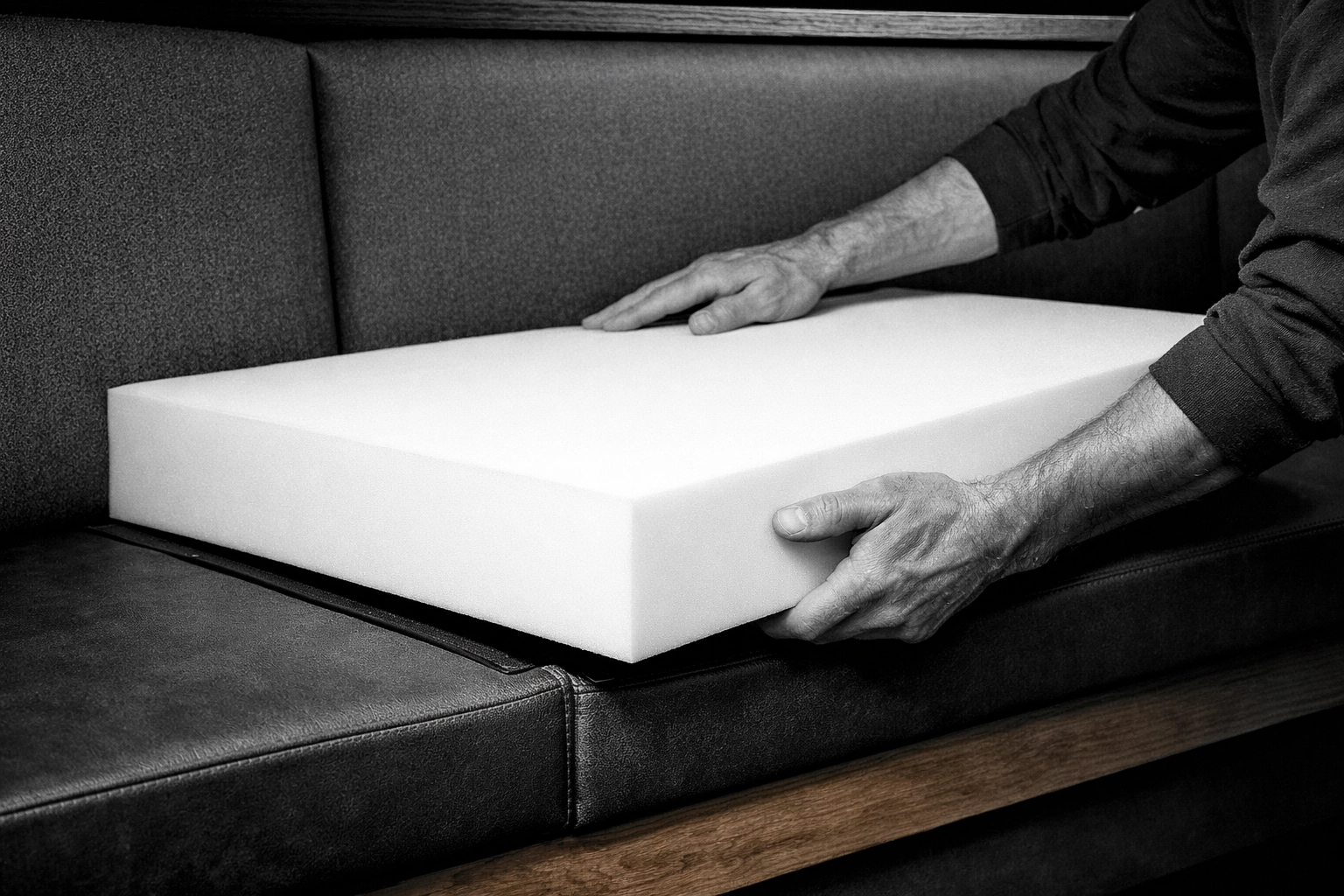
AI image prompt suggestion: “Clean, modern restaurant booth seating cross-section showing foam layers, simple labels for seat foam and batting, neutral colors, photo-real style.”
Residential furniture (sofas, cushions, window seats)
Home seating is about comfort and support. You want “sink in” without bottoming out.
Sofas and chairs
- Use supportive foam in the seat.
- Use softer foam (or fiber) for backs if you like plush.
Bench cushions and window seats
- Thickness is the game changer.
- Too thin = hard and unhappy.
- Too soft = you feel the base.
Seat cushion quick targets (general)
- 4"–6" thick is common
- add a wrap (like batting/Dacron) for a smoother, fuller look
If you’re restoring a family sofa, Stuff It Upholstery can match the vibe: firmer, softer, taller, cleaner edges: without the “why does this feel weird?” surprise.
Why automotive-grade foam is awesome at home (without doing car upholstery)
You don’t need a car project to benefit from automotive-grade foam. It’s a killer upgrade for home seating.
Why people love it:
- built for heavy use
- great resilience
- holds shape
- less “pancake” over time
Best home uses:
- kitchen banquettes
- playroom benches
- home theater seating
- rental properties
- frequently used sofa cushions
If you’ve replaced cushions before and they went flat fast, ask Stuff It Upholstery about automotive-grade foam options for residential builds. Same cozy goal. Better staying power.
Measuring: do it once, do it right
Bad measurements waste time and money. Be picky.
For rectangle cushions
Measure:
- width
- depth
- thickness
Then check:
- Are the corners rounded?
- Is the cushion slightly trapezoid?
- Does it taper?
For irregular shapes
Do this:
- Lay kraft paper or cardboard on the surface.
- Trace the shape.
- Mark front/back and top/bottom.
- Note any bevels or curves.
For replacing foam inside a cover
Measure the cover, not the old foam… and then compare both.
- Old foam may be compressed.
- Covers stretch differently depending on fabric.
Tiny rule that saves projects:
If the cover is snug, foam may need to be slightly oversized for a full look. If the cover is stiff/non-stretch, you may need a cleaner exact fit.
Not sure? Bring the cover in. Stuff It Upholstery does this kind of fit check all the time.
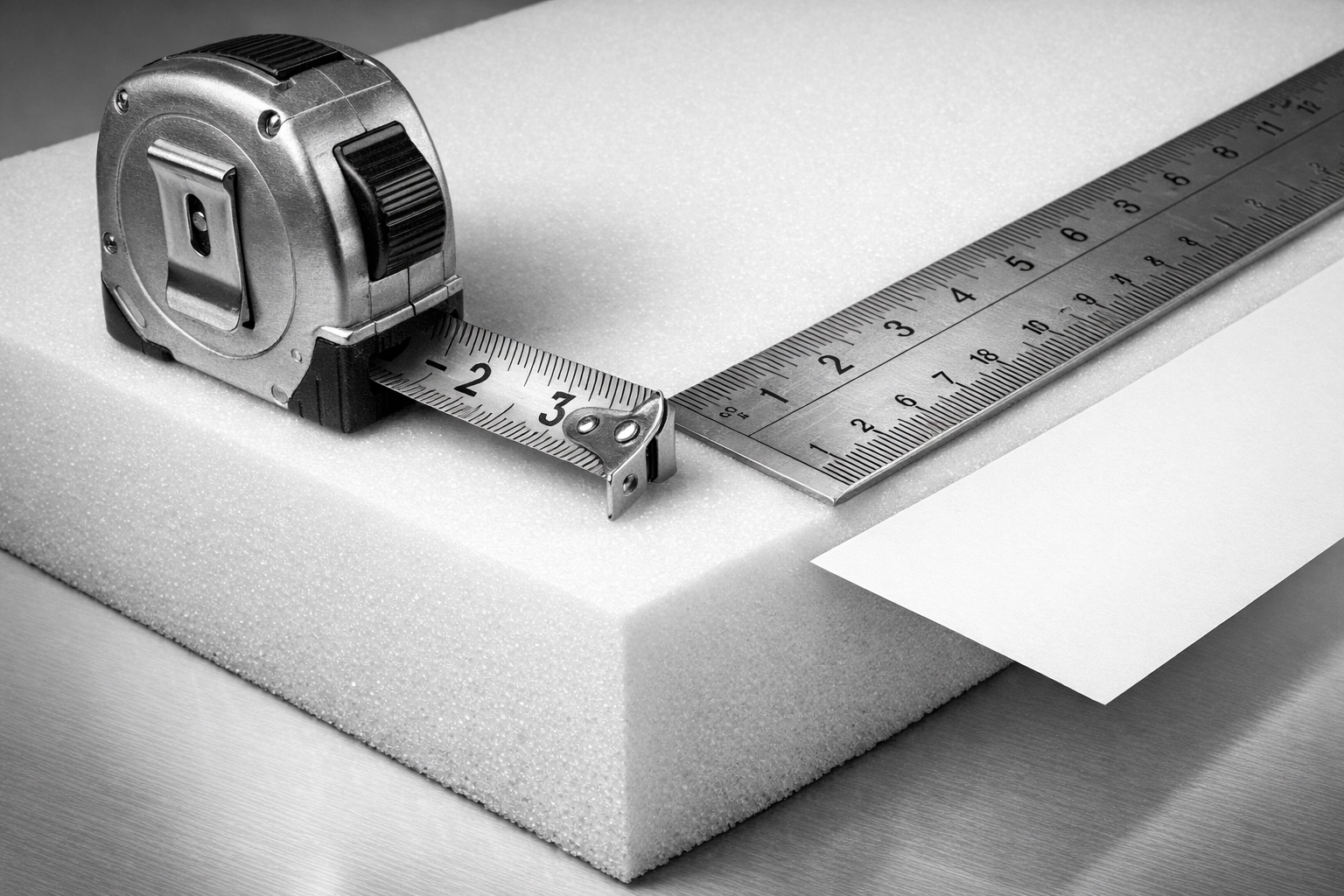
AI image prompt suggestion: “Top-down view of a cushion template on kraft paper with measurement marks, pencil, tape measure, simple labels for width/depth, bright workshop lighting.”
Cutting methods: what “custom-cut” can mean
Not all cuts are equal. The method affects edge quality, accuracy, and repeatability.
Common cutting options (plain-English version)
- CNC knife cutting: great for complex profiles, consistent shapes
- Waterjet cutting: super clean, precise, good for thicker foams
- Die cutting: best for high volume + simple shapes (tooling required)
- Hot wire/thermal: fast for simpler profiles (depends on foam type)
- Contour cutting: good for curves and 2D shapes
Pick based on:
- shape complexity
- foam thickness
- how many pieces you need
- how clean you want edges
For one-off furniture cushions, you usually want accuracy and clean edges more than industrial speed. That’s where Stuff It Upholstery shines: fit, finish, and comfort first.
Layering foam (the secret weapon)
One slab isn’t always the answer. Layering lets you tune comfort.
Common layer builds
- firm base + softer top: supportive but comfy
- foam + wrap (batting/Dacron): smoother look, fewer sharp edges
- multiple layers for height: better than one ultra-soft thick piece
When layering helps most:
- bench seats over plywood
- extra-tall cushions
- pressure point problems
- “too firm but I like the support” complaints
If you’re chasing that “new showroom feel,” ask Stuff It Upholstery about layered builds. It’s a simple upgrade with big results.
Cutouts, notches, and special details
Custom-cut foam isn’t just outer shape. Details matter.
Popular add-ons:
- hinge notches for flip-top benches
- radius corners to match covers
- tapers for angled backs
- channels for seams or tufting zones
- finger cutouts for removable inserts
If you’re doing built-in seating for a breakfast nook or a commercial banquette, these details reduce wrinkles and improve fit fast.
Foam + fabric = the real comfort equation
Foam can be perfect and still feel “off” if the cover fights it.
Keep these in mind:
- Thick fabrics can make cushions feel firmer.
- Non-stretch fabrics demand cleaner dimensions.
- Leather/vinyl behave differently than woven upholstery.
- Loose covers need a little extra “stuff” to look full.
That’s why working with a shop like Stuff It Upholstery helps. We think about the whole system: foam, wrap, fabric, and how it all sits when someone actually uses it.
Common mistakes (quick fixes)
Mistake: Picking foam only by thickness
Fix: Match thickness and density and feel
Mistake: Reusing worn-out wrap
Fix: Add fresh batting for smoother edges and better loft
Mistake: Measuring old foam that’s compressed
Fix: Measure the cover and the seat deck too
Mistake: Going too soft for dining/booths
Fix: Choose medium-to-firm for support and longevity
Mistake: Ignoring how the cushion is supported (slats, plywood, webbing)
Fix: Firmer foam for hard bases; layered build for comfort
Simple “buying checklist” you can copy/paste
Bring this list when you talk to Stuff It Upholstery.
- Project type: commercial / residential
- Piece: seat / back / bench / cushion set
- Dimensions: W x D x T
- Shape: rectangle / radius corners / template provided
- Comfort goal: soft / medium / firm
- Usage level: occasional / daily / heavy traffic
- Base: plywood / slats / springs / webbing
- Cover: fabric type + snug or loose
- Notes: layering, wrap, tapers, cutouts
Want to browse what we do and see project examples? Start at Stuff It Upholstery: https://stuffitupholstery.com
When to call Stuff It Upholstery (and save yourself the redo)
DIY foam is doable. But if any of these are true, get help:
- you need an exact fit for a tight cover
- the shape is odd (curves, tapers, built-ins)
- it’s for a bar/restaurant and has to last
- you want that “new furniture” feel, not just “good enough”
- you’re upgrading to premium or automotive-grade foam for home use
Stuff It Upholstery can guide the specs, cut it clean, and build it to perform: whether it’s a single sofa cushion or a full set of commercial booths.

